15.01.2026
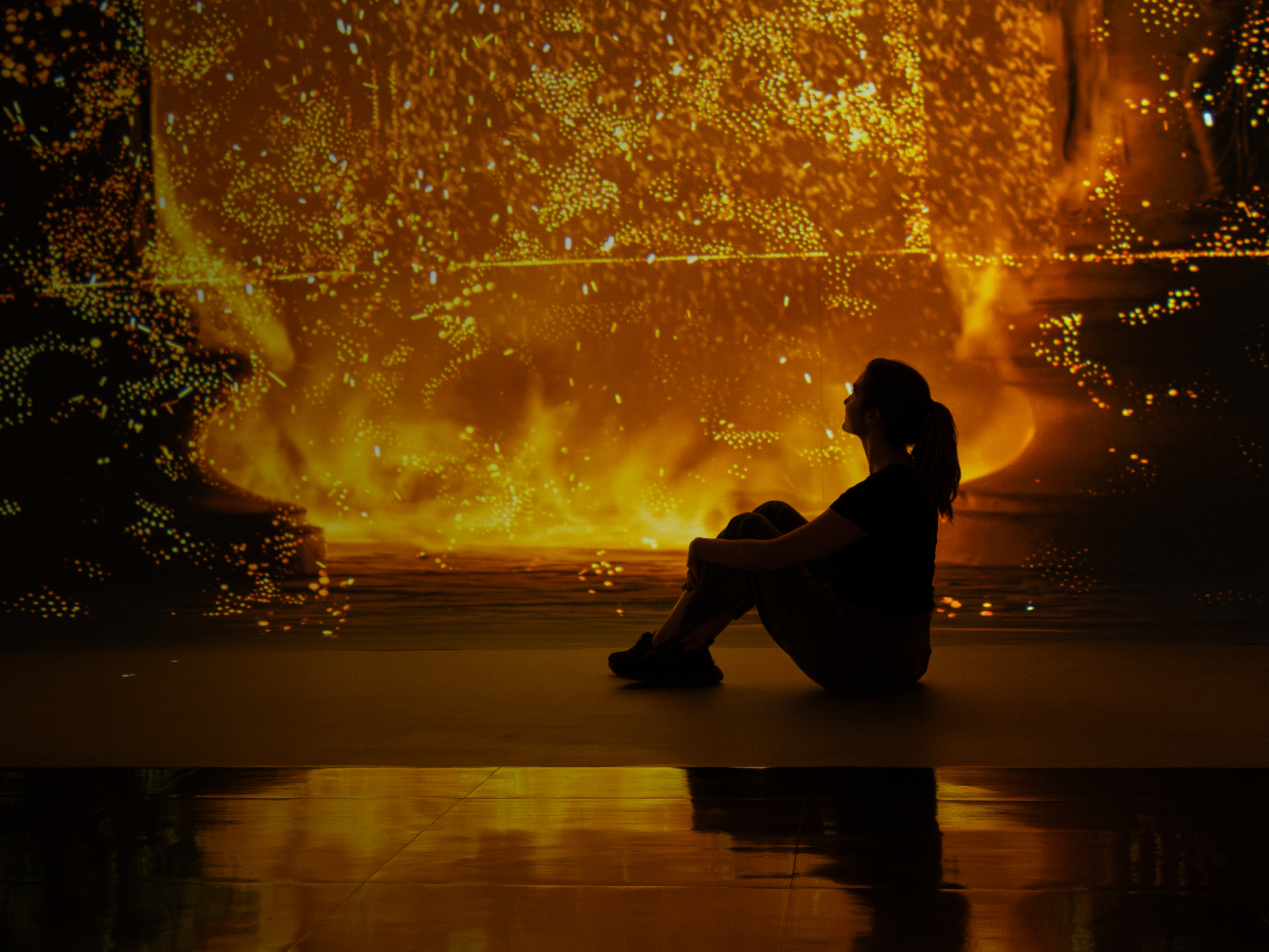
Day by day, as we step into new museums, it becomes clear how rapidly the experience is transforming: interactive screens, immersive projections, and “smart” exhibits now respond to our curiosities; further, we find ourselves in glowing chambers of light where images are sliding across the walls, music breathing through the air, and where visitors are already angling their phones toward the ceiling because they have discovered something worthy of sharing. In that moment you can feel that the paradigm of engagement has changed; the pulse of a new age and a new generation has come. Each new generation is born into a world filled with ever more stimuli. They don’t just want to watch; they want to step inside a phygital experience, something they’ve grown entirely accustomed to. It’s how we now interact with reality; it’s our new normal, and we do it seamlessly every day, through the comfort of our smart devices that surround us from the moment we wake up till we sleep.
In this blog, we are to wander into the museum experiences of young adults through their engagement with new-age museology venues, experiential spaces, and experience museums that have begun to mainstream themselves from the metropoles of the world, from São Paulo to London, and from İstanbul to Tokyo.
The first impression of these spaces is that they draw their audience not only to beauty but also to the sensation of being included in something alive. In one word, truly immersive in the experiences they provide. It is a new quality and a new approach to engaging with museums and with experiences in general. Along with Gen-Z, as society gradually rehabilitates itself to the authority of the digital transformation in its everyday transactions, we no longer engage with, or rather, wish to treat museums in the old static forms; we want to see them as a living organism where light, sound, and human bodies fold together into a memorable experience.
When we speak of Gen Z engagement with museums, on one side, what they tell us is simple: they want museums to feel like places to be together, where they can linger, talk, and share in the same way their parents once did in bookshops or record stores. It is an opportunity for friends to come together, and even a safe and neutral space to have one’s first date.
On the other hand, however, what Gen-Z wants is to play a role in the story. They prefer to draw on digital walls or cast votes that alter the narrative path or leave behind a message that becomes part of the exhibition itself. They want to feel that their handprints are inside the exhibition. And of course, they expect technology to be woven with augmented reality and gamified projections that reflect the very media habits they have grown up with, either through social media, mobile phones, or video games.
There is a science to what is happening here that is worth pausing to. A recent, experimental study by Feitosa and Barbosa, published in Marketing & Tourism Review (2020), offers a fascinating glimpse into how Generation Z connects with technology inside museums. The research, carried out with 298 young visitors in São Paulo, compares experiences in traditional galleries with those using high levels of digital tools such as VR, interactive screens, and projections. The results indicate that museums that blend storytelling with technology create stronger emotional excitement, visitor satisfaction, and a greater sense of quality. In fact, on a correlation scale that ranges from 0 to 1, where 0 represents no relationship at all and 1 represents a perfect relationship, the study found a 0.68 correlation between perceived quality and emotional arousal, and an even higher 0.87 correlation between that arousal and the likelihood of sharing the experience online. Mind that it is an incredibly high score. If we are to summarize in simple terms, in regard to user behavior, the more Gen Z feels something, the more they post about it, so word-of-mouth advocacy is highly likely.
Yet Feitosa and Barbosa also remind us that technology alone is not enough. The warmth of a well-trained guide, the clarity of interpretation, and the empathy of museum staff remain crucial ingredients for a memorable visit. Therefore, operational quality, staff empathy, and training remain vital to achieving positive visitor experiences. It is, in fact, the driving input of all engagement; visitors expect to see human connection instead of aloof and disengaged corridors with signs. Here, their takeaway is refreshingly balanced: Museums shouldn’t chase tech for tech’s sake. The research further argues that the real magic happens when digital tools and human connection meet in harmony, turning museums into living spaces of participation and curiosity. Museums should be utilized as mediums that deepen meaning, make learning feel alive, and provide emotional connection. For Gen Z, a museum is an arena for co-creation, storytelling, and shared emotion; it is where the line between learning and feeling entirely merges.
You can see it for yourself: walk into an immersive gallery and look around, and you will find phones raised like torches in a cavern, capturing moments that are not just pretty images but also narratives for personal IG content– selfies, interaction points, reminders, archives, etc. Gen Z uses these spaces as backdrops for stories about who they are, what they feel, and how they wish to be seen. The museum becomes both a stage and a mirror for the persona they wish to build. It is reimagined as a place where their individuality can shimmer against the communal glow of projection and sound– it is how they stand out in the crowd.
They duet each other’s clips on TikTok, layering experience, and the result is that every museum moment is magnified, retold, reframed, and sent further into the digital ether. In this sense, Gen Z acts as both audience and ambassador, spreading the museum’s reach through channels that museums could never purchase directly.
As with all changes, there are also critics who claim that experiential design is only spectacle– all glitter and light without weight. Yet when you trace the memory of a Gen Z visitor weeks later, you find that the story remains. Narrative-driven projections and VR exhibits create a depth of recall that traditional displays cannot match, because emotion engraves itself more deeply than facts written on a wall. Learning takes place if only the emotions are properly engaged.
It is like reading history in a dry textbook versus hearing your grandmother tell you a story about the night she first saw the stars in the countryside. One might give you the details, but the other gives you the feeling, and it is the feeling that lingers.
So what should museums do, if they wish to captivate this generation that craves immersion, community, and meaning?
They can design spaces that invite co-creation, where visitors leave traces of their own voices. They can craft multisensory storytelling that includes sound, touch, and even scent so that the body remembers what the mind might forget. They can create hangout spaces where conversation is encouraged, honoring the desire for museums to act as social hearths. They can measure engagement and adapt, learning continuously from digital footprints, surveys, and social resonance. And they can recognize the rising role of museums as places of civic wellness, offering moments of reflection, mental rest, and collective care in a noisy world.
When we think of Gen Z in museums, we should think of them not as passive visitors but as co-authors of the cultural story we are all writing together. They do not come to observe; they come to belong, to contribute, to share, to feel. In their hands, the museum is not a temple, rather, it is more like a campfire where stories are told and retold, glowing brighter with each new narrative voice.
It wouldn’t be bold, therefore, to conclude that as long as museums are willing to embrace this transformation, they will find themselves at the center of a movement, carried forward by the very generation that loves to create, amplify, and reimagine the world.
So if you are also interested in experiential design and wish to engage with the new-age museology venues, we are inviting you to visit our award-winning experience museums!
When you are visiting Istanbul, wandering through the heart of the city, let your curiosity guide you to the Hagia Sophia History and Experience Museum in Sultanahmet, just steps away from the world-renowned Hagia Sophia Grand Mosque. Our immersive museum brings centuries of history to life through cutting-edge projection mapping, spatial sound design, and digital storytelling, where you can walk through time and witness the rise of empires and the blending of faiths that shaped Istanbul’s soul. The museum welcomes guests year-round, making it an ideal stop before or after exploring the nearby landmarks, such as Blue Mosque or Topkapı Palace.
And if your travels take you to the sun-soaked lands of the Aegean, step into the Ephesus Experience Museum in Selçuk, İzmir, situated directly inside the ancient city of Ephesus itself. Here, history unfolds in vivid 360° narratives that transport you straight into the life and legend of this Greco-Roman marvel. Our museum’s innovative multisensory environments and cinematic storytelling let you feel the rhythm of ancient streets, temples, and marketplaces, intertwining myth and history in a unique fusion. A prior visit to the museum, is a perfect complement to your visualization of the Harbour (Arcadiane) Street, Terrace Houses, or the Great Theatre of Ephesus at their prime, so make sure to take part in the experience before you visit the ancient site.
See you at our next blog!
