07.10.2025
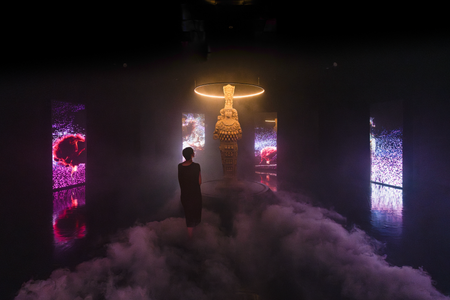
Human memory is rarely neutral. What we remember most vividly is often tied to the senses. The crackle of a fireplace, the texture of rough stone, the scent of a familiar dish… these are details that turn fleeting moments into durable recollections. Experience design, particularly in cultural and museum settings, increasingly recognises this truth: when more senses are engaged, the stronger the imprint on memory.
In this respect, the five human senses– sight, sound, smell, touch, and taste– are not simply biological functions. They are tools for storytelling, each contributing in distinct but complementary ways.
Visual information plays a dominant role in how humans perceive the world. Neuroscience research suggests that nearly half of the brain is involved in visual processing. In fact, this percentage includes not just the primary visual cortex, but also the numerous other areas that process motion, colour, form, and spatial relationships. Visual information is a primary input for navigating the world, contributing to its powerful role in perception and memory formation. For this reason, sight functions as the foundation of most designed experiences.
In practice, sight provides structure. Maps, diagrams, photographs, or large-scale projections serve as the “skeleton” of an experience, offering clarity and orientation. Consider the way a film relies on visual framing to guide narrative flow. In museums, carefully orchestrated visuals can transform static history into a dynamic presence. Without sight, memory lacks scaffolding; with it, stories acquire shape and coherence.
If sight constructs the framework, sound adds atmosphere. Unlike visuals, which are usually deliberate and foregrounded, sound often operates on a subtler level. It sets tone, modulates pace, and conveys emotion.
Think of how cinema employs soundtracks: the same scene becomes comic with light music, ominous with low strings. Similarly, in cultural spaces, footsteps echoing in a vaulted hall, or voices narrating history in multiple languages, deepen immersion. Sound provides rhythm and resonance, ensuring that what is seen is also felt.
Smell functions differently from sight or sound. It is less analytical, more associative, and neurologically connected to the limbic system– the brain’s centre for memory and emotion.
Think of your brain's processing of smell as a special shortcut.
While other senses like sight and sound have to pass through a relay station in the brain first, smell goes directly to the parts of the brain that handle emotions (amygdala) and memory (hippocampus). This direct link explains why a particular scent can instantly and powerfully trigger a vivid, often emotional memory, such as the smell of a certain perfume evoking a memory of a loved one.
This explains the so-called “Proust effect,” when the scent of something ordinary, like a pastry or a flower, evokes forgotten moments with remarkable clarity.
Applied to experience design, smell acts as a direct path into memory. Imagine an exhibition about maritime trade accompanied by the faint aroma of salt and tar, or a historical setting where the scent of incense drifts through the air. These subtle cues do not simply illustrate history; they transport visitors into it.
Touch brings immediacy. It affirms reality by allowing the body to verify what the eye perceives. While fragile artefacts often prevent direct handling, creative alternatives exist, including replicas, interactive surfaces, haptic feedback, and environmental elements such as temperature and airflow.
Consider how children learn: by reaching, grasping, pressing, and feeling. The same principle applies in cultural experiences. A smooth surface contrasted with a rough one, or a sudden drop in temperature in a simulated cave environment, can translate abstract history into embodied understanding. Touch grounds information in physicality.
Taste is the least common sense in designed cultural experiences, primarily due to logistical and hygienic challenges. Yet when it is employed, its impact is substantial. Taste, like smell, is visceral and deeply connected to memory.
Think of historical reconstructions of feasts, where even a small sample, such as spiced wine, a piece of bread baked with ancient grains, etc., offers not just a flavour but a direct link to another time. Taste makes history social, participatory, and embodied. Though rarely used, it has the potential to transform observation into lived experience.
While the full spectrum of sensory engagement remains an aspiration in many cultural projects, some institutions are advancing this field through sight and sound with notable success. DEM Museums, based in Türkiye, provides a valuable case study.
At the Hagia Sophia History and Experience Museum, digital projections narrate the Byzantine and Ottoman eras across multiple floors, with world-renowned multi-lingual voice-overs. Meanwhile, never-before-seen artefacts crown the experience with tangible history. Similarly, the Ephesus Experience Museum employs expansive visual storytelling and multilingual audio to guide visitors through myth and archaeology.
These projects illustrate how three dominant senses – sight, sound, and smell – can already create memorable experiences when orchestrated with precision. Yet they also highlight the untapped potential of a fully multisensory approach.
Experience design is, at its core, about communication. The more senses it enlists, the more complete the message becomes. Sight and sound establish the narrative. Smell, touch, and taste add nuance, depth, and resonance. When they are orchestrated in a meaningful bundle, they do not just tell a story; they make your experience unforgettable.
