20.05.2026
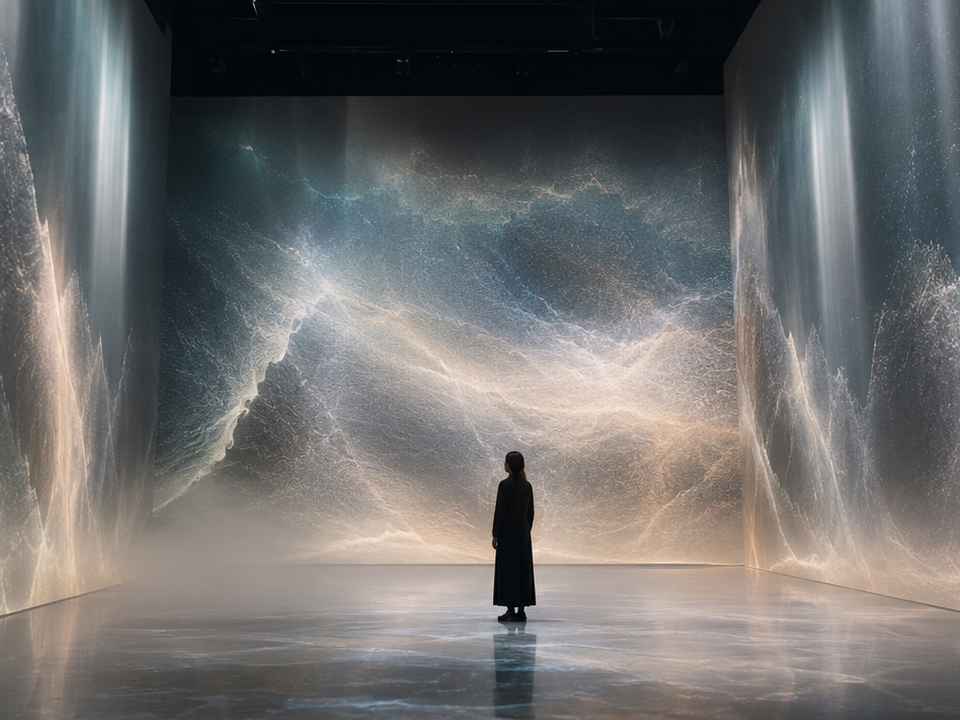
Museums are powerful narrative spaces that transport visitors to different times, cultures, and stories. Today, as these narratives become increasingly layered and immersive, the museum experience is evolving beyond simply presenting information into a journey that visitors feel, connect with, and remember.
People no longer want only to observe; they want to be part of the experience, create meaning, and leave their own trace within it. At this point, however, an important balance emerges: explaining everything, showing every detail, and filling every moment does not always create a stronger experience. On the contrary, the most impactful moments often arise when the narrative slows down and gives space to the visitor.
In the museum experience, silence is often misunderstood. Yet silence is not emptiness; it is a conscious choice. It is a layer of experience that allows visitors to think, observe, and form their own interpretations. Spending a few uninterrupted moments in front of an artwork enables visitors to establish a personal connection with it. This connection is far more lasting than information delivered externally. Because at that moment, the visitor is no longer merely an observer, but a participant who completes the experience internally.
A powerful museum experience is built upon rhythm. This rhythm emerges through the balance between moments of intense storytelling, areas of discovery, and moments of pause. Pauses are the moments when visitors digest the experience, mentally refocus, and establish emotional connections. An experience that moves in constant flow may eventually lose its impact. A brief silence, however, strengthens the narrative and makes the next layer of experience more meaningful. For this reason, silence is not simply an interruption; it is one of the most essential parts of the experience itself.
When visitors leave a museum, they rarely remember all the information they encountered. What remains in memory are certain moments: an atmosphere, a light, a sound, or a brief pause. These moments define the true value of the experience. Silence allows such moments to emerge. It offers visitors a space in which they can construct their own stories. Through this space, the museum experience becomes personalized and creates a deeper emotional impact.
DEM Museum approaches the museum experience not merely as content production, but as a holistic narrative design. Within this approach, what visitors feel is considered just as important as what they see. The narrative is shaped through a multilayered structure in which storytelling, spatial design, lighting, sound, and advanced technologies work together in harmony.
This approach can be clearly seen in projects such as Ephesus Experience Museum and Hagia Sophia History and Experience Museum. In these projects, the experience is not constructed on a single layer, but through a system where multiple disciplines operate in synchronization. Through immersive projection systems, mapping technologies, high-resolution visual systems, and three-dimensional sound design, visitors are transported beyond the physical boundaries of the space they occupy. Thanks to this technological infrastructure, visitors become not only spectators, but active participants moving within the story and transforming together with the environment around them. By combining visuals, sound, and atmospheric effects, a multisensory narrative is created, allowing historical storytelling to be experienced not merely as information, but as a felt and lived journey.
According to the DEM Museum approach, experience is constructed through rhythm. While moments where the narrative intensifies reach visual and auditory peaks, the moments of simplification and pause that follow are designed intentionally. For example, transitions between scenes may involve dimming lights, fading sounds, or the creation of a sense of spatial emptiness, allowing visitors space to absorb the experience. At this point, technology withdraws and gives way to silence. Because powerful impact emerges not only through highly intense content, but also through the emptiness that follows it. Within the DEM Museum approach, silence is not a weak moment of the experience, but one of its strongest layers.
At the same time, a successful flow does not showcase technology itself, but rather makes technology invisible in order to deepen the experience. It offers visitors both an intense narrative and spaces where they can internalize that narrative. In this way, the experience transforms from a story that is merely watched into a journey completed within the visitor’s mind and emotions.
